











What is container technology?
Understanding containers from life metaphors
Imagine you're moving: whereas the traditional way is to stack all your belongings haphazardly on a truck, the modern way is to use standardized containers. Inside each container are neatly arranged items for a specific room, and the containers themselves are uniform in size for easy transportation and stacking.
Container technology is the "standardized container" of the software world.Container. It packages an application and all its dependencies (code, runtime environment, system tools, system libraries, etc.) into a single, portable unit that we call a "container".
Core features of the container
- isolation: Each container has its own filesystem, network configuration and process space, and does not interfere with each other
- weightlessness: Containers share the host operating system kernel, requiring no additional operating system overhead
- portability (programming language): build once, run everywhere (whether on a development laptop, test environment or production server)
- efficiency: Fast start-up, usually in a few seconds
How traditional virtualization technologies work
Basic Concepts of Virtualization
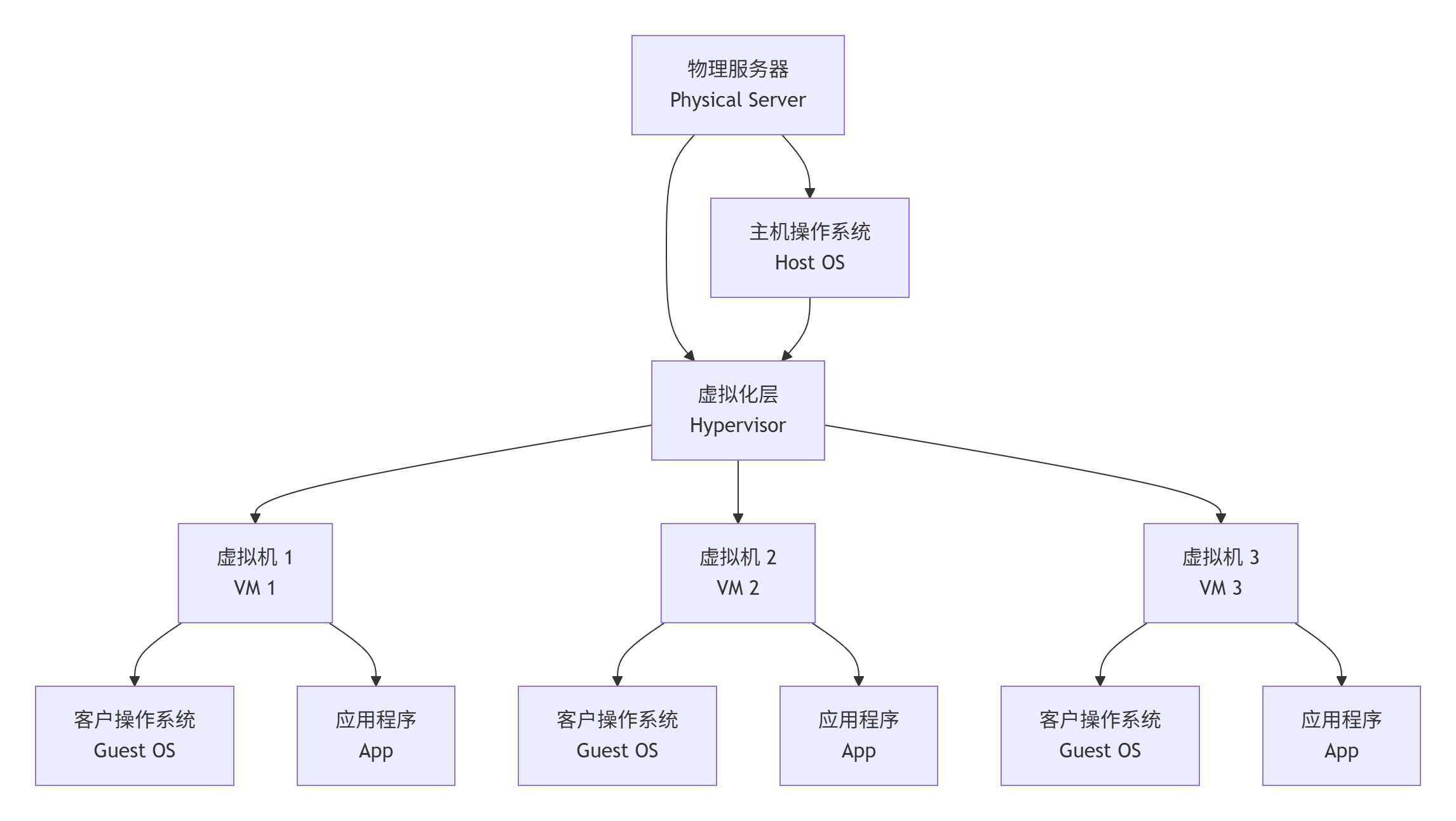
Traditional virtualization technologies (e.g., VMware, VirtualBox) create multiple physical servers on a singleComplete Virtual Machines. Each virtual machine contains:
- A complete set of operating systems (Guest OS)
- Applications and their dependencies
- Virtual hardware resources (virtual CPU, virtual memory, virtual disks, etc.)
Architecture for Virtualization
Advantages and Disadvantages of Virtualization
Advantages::
- Complete isolation and high security
- Can run operating systems of different architectures (e.g., Windows on a Linux server)
Disadvantages::
- High resource consumption (each VM requires a full operating system)
- Slow startup (need to boot the entire operating system)
- Performance has additional overhead
How Docker Container Technology Works
Basic Concepts of Docker
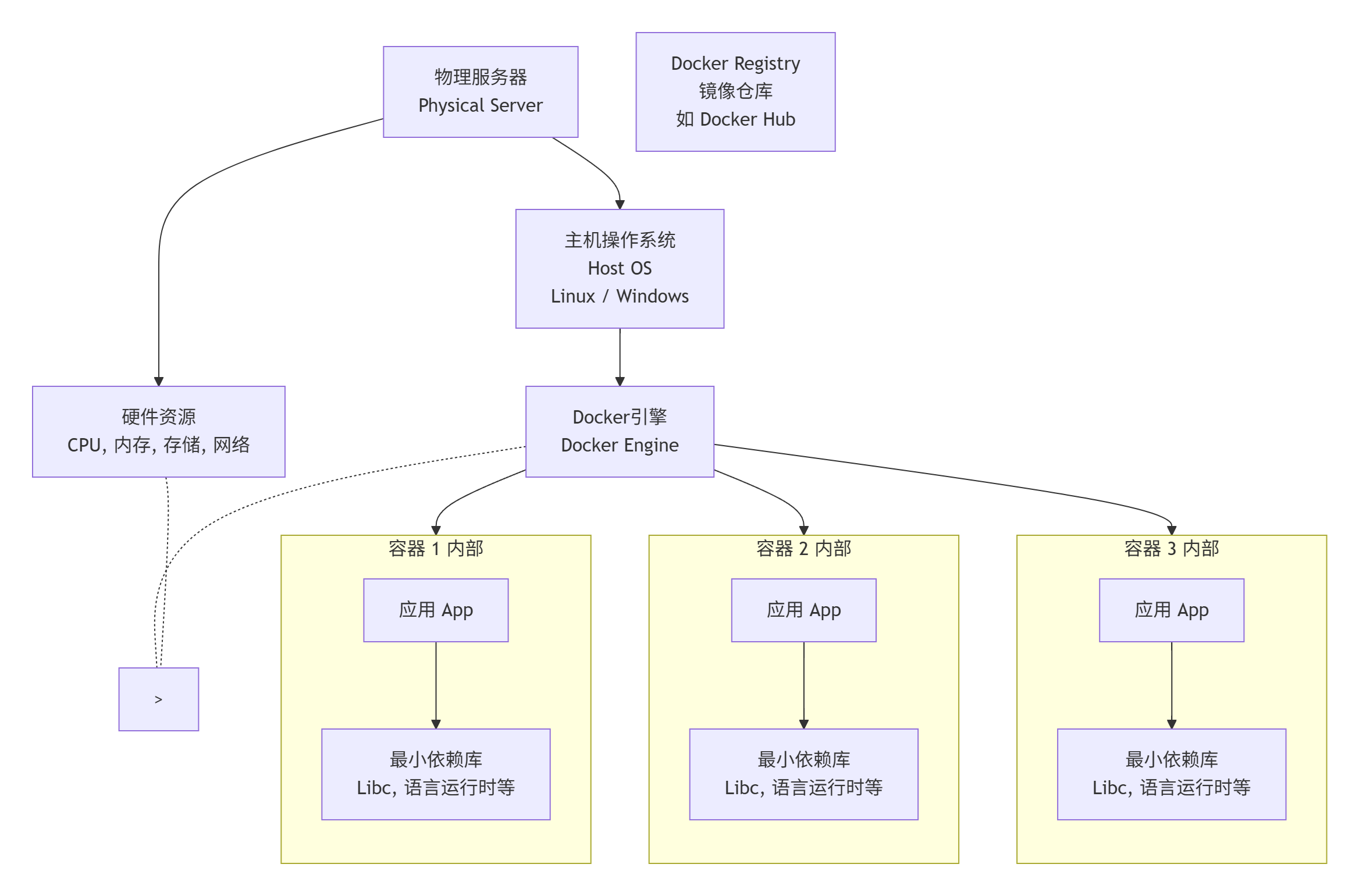
Docker is the most popular container technology implementation today. Unlike virtualization, Docker containersNo need for a full operating system, but rather the kernel of the shared host operating system.
Architecture of Docker
Composition of packagings
A Docker container contains:
- the application itself
- Libraries and dependencies needed to run
- Basic system tools (minimum set)
- exclusive ofComplete operating system kernel
Key differences between Docker and virtualization
Comparison of resource utilization rates
| characterization | Traditional Virtualization | Docker containers |
|---|---|---|
| operating system | Full OS per VM | Shared host OS kernel |
| disk space | Usually GB level | Typical MB level |
| activation time | minutes scale | second level |
| Performance loss | Higher (10-20%) | Very low (1-2%) |
Comparison of Architectural Differences
Traditional Virtualization: Physical Hardware → Host OS → Hypervisor → Guest OS → Applications
Docker containers: Physical Hardware → Host OS → Docker Engine → Application
Differences in usage scenarios
Virtualization is suitable for::
- Situations where different operating systems need to be run
- Scenarios with high isolation requirements
- Traditional enterprise application deployment
Vessel fit::
- Cloud Native Applications and Microservices Architecture
- Continuous integration and continuous deployment (CI/CD)
- High-density deployment scenarios (need to run a large number of instances)
Why is container technology so popular?
Alignment of development and operations
Containers ensure the consistency of the "development environment, test environment, production environment", solving the classic problem: "It's fine on my computer, but it's not fine on the server."
Elastic Scaling and Microservices
The lightweight nature of containers makes them ideal for microservices architectures, with the ability to quickly start and stop instances and automate scaling up and down.
DevOps Culture Push
Container technology fits perfectly with the DevOps philosophy and supports modern software development practices such as automated deployment and rolling updates.
Examples of practical applications
Deploying Web Applications the Traditional Way
Suppose a Python web application needs to be deployed, the traditional way requires:
- Installation of the operating system
- Installing the Python Runtime
- Installation of dependent libraries (e.g. Django, MySQL drivers, etc.)
- Configuring Environment Variables
- Deploying Application Code
This process is error prone and difficult to reproduce.
Deploying with Docker
Use Docker only:
- Write a Dockerfile (define the build steps)
- Run
docker buildcommand to generate an image - Run
docker runLaunch Container
The entire process is repeatable, automated, and completely consistent.
summarize
Container technology (and Docker in particular) is not a replacement for traditional virtualization, but rathercomplementary technology, they address different dimensions of the problem:
- virtualization: Focus onSegregation and allocation of hardware resourcesProvide a complete system environment
- containers: Focus onIsolation and portability of the application itselfThe company provides lightweight operating environments
In modern IT architectures, it's common to see the two used in combination: running containers on VMs, enjoying the hardware isolation benefits of virtualization while gaining the application portability benefits of containers.
Understanding this distinction is critical to entering the modern software development space, where container technology has become the de facto standard for application deployment in the cloud era.
 English