


















If you use WordPress to create a content website, a blog, a corporate website, or an e-commerce website, SEO plugins are usually one of the basic configurations. My recommendation is to start with Rank Math SEO To start with, because it centralizes title descriptions, site maps, structured data, indexing rules, and page optimization into a single tool, it's ideal for long-term maintenance. Below, we'll explain how to use it to set up a basic SEO process, based on applicable scenarios, recommended reasons, version selection, and getting started steps.
Applicable scenarios: Which websites are recommended for priority use?
Rank Math SEO isn't just suitable for a single type of website. As long as your website relies on search traffic, content publishing, and page conversions, it's worth giving priority to it.
| Type of website | The reasons why I recommend using Rank Math SEO | \nPriority configuration items |
|---|---|---|
| Blogs and content websites | The number of articles continues to increase, and it is necessary to standardize the titles, descriptions, keywords, internal links, and structured data. | Article SEO, site map, category index, breadcrumbs |
| The official website of SMEs | The service page, case page, and product page need to be more clearly recognized by search engines | Homepage title, service page description, local business information, structured data |
| Affiliate marketing website | Pages usually serve the functions of product guidance and conversion, and it's necessary to control the indexing, internal links, and summary display of the pages | Article optimization, redirection, link management, and social sharing information |
| WooCommerce website | Products, categories, tags, and articles coexist, and the page structure is more complex | Product page SEO, product structured data, category page rules, and site map |
| Multi-site operators | It is necessary to reuse a more stable SEO workflow across multiple WordPress websites. | Modular functions, import and export, and unified configuration habits |
If you only need very lightweight automated configuration, you might consider \nSlim SEOIf you want to compare different interfaces and workflows, you can also learn about them. SEOPress Or Yoast SEOHowever, if the goal is to manage content, page structure, and search traffic over the long term, Rank Math SEO is usually a more suitable tool of choice.
Recommendation reason: Why put it on the priority list?
I recommend Rank Math SEO mainly because it can cover most of the high-frequency SEO tasks for WordPress websites, rather than just solving a single problem.
1 The functions are fully comprehensive
Most common SEO basics can be completed in Rank Math SEO:
- SEO titles and descriptions: Set the content displayed in search results for the homepage, articles, pages, categories, and product pages.
- Keyword check: Helps editors confirm whether the article is centered around the core topic.
- Site map: Automatically generate and manage entry points to articles, pages, categories, products, and other content.
- Index control: Determine which pages are allowed to be indexed and which pages should be avoided from being included in the index.
- Structured data: Add more clear machine-readable information to content such as articles, products, courses, and frequently asked questions.
- Breadcrumbs: They improve the hierarchical display of the site and also help users understand the location of the page.
- Redirection: Handling the redirect needs caused by old links, revised links, and deleted pages.
- 404 Monitoring: Detects the invalid addresses accessed by users or search engines.
- Search engine tool connection: Combine the site data with the plugin backend to facilitate problem diagnosis.
- Social sharing information: Control the title, description, and images when sharing articles on social platforms.
2 The free version has high starting requirements
Many new websites are not suitable for purchasing complex tools right from the start. The free version of Rank Math SEO can already handle basic SEO tasks, including title descriptions, site maps, indexing rules, article optimization suggestions, structured data, and some maintenance functions. For individual webmasters, small teams, and newly launched corporate websites, they can first use the free version to smooth out the process, and then decide whether to upgrade based on the scale of their website.
3 There is enough room for future expansion
In the early stages of a website, basic configuration is usually all that's needed; once the amount of content increases, bulk optimization, redirect management, more structured data, team collaboration, data analysis, and automation requirements will emerge. The advantage of Rank Math SEO is that you can start with the basics and then add features as needed, without having to frequently replace plugins.
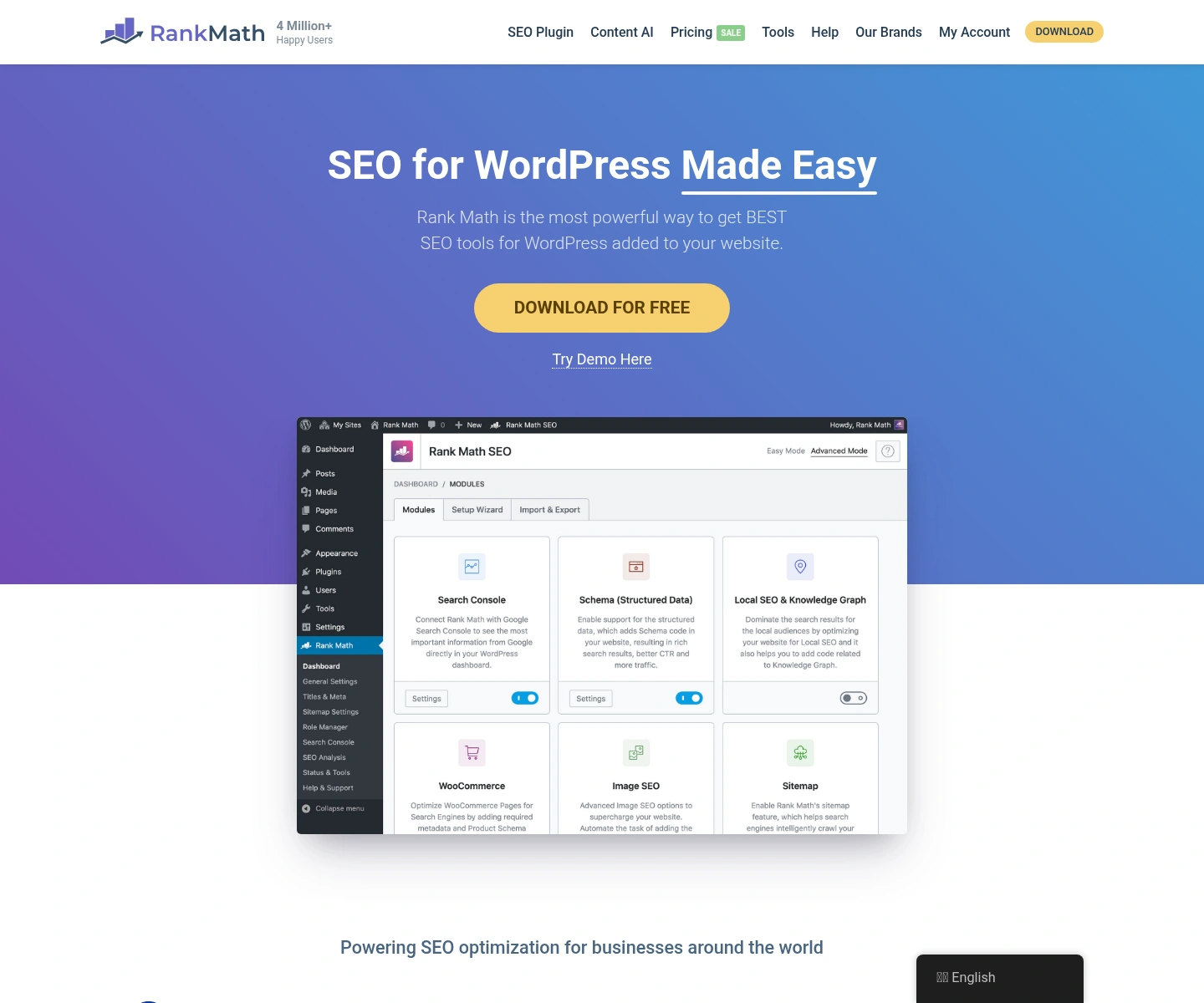
Function list: Suggest which modules should be used as a priority
After installing Rank Math SEO, it is not recommended to enable all modules at once. A more practical approach is to enable them according to their priority.
1 Essential functions
| functionality | Use | suggestion |
|---|---|---|
| SEO title and description | Control the display of pages in the search results | It is recommended to handwrite the homepage, core pages, and key articles |
| Site Map | Help search engines discover important content | Submit it to the search engine tool and exclude low-value pages |
| Index settings | Control whether the page is included in the index | The categories, tags, and author pages should be determined according to the website's structure |
| Article Optimization Panel | Check the basic SEO items before publishing | As a checklist, don't mechanically pursue a perfect score |
| Structured data | Help search engines understand the type of content | Prioritize the settings for pages such as articles, products, and frequently asked questions |
2 It is recommended to enable this function.
- Breadcrumbs: Suitable for websites with a large number of content layers, especially blogs, tutorial sites, and product classification sites.
- Redirection: Suitable for sites that have changed links, merged old articles, deleted pages, or undergone website redesigns.
- 404 Monitoring: Suitable for websites that have been in operation for a while and have many external links.
- Social sharing settings: Suitable for websites that rely on social media dissemination, community distribution, and content forwarding.
- WooCommerce-related features: Suitable for e-commerce websites with many product pages and category pages.
3 Functions that can be temporarily suspended
If you're a new website owner, you can address the following functions after the basic processes have stabilized:
- Complex batch rules.
- Advanced structured data templates.
- Large-scale redirection and organization.
- Unified management of multiple websites.
- Deep data analysis and automated optimization.
First, make sure that the following tasks are completed properly: ensuring that the website can be properly crawled, providing title descriptions for important pages, conducting checks before content is published, and preventing a large number of old links from becoming invalid. By doing these things well, the benefits will be more direct.

How to choose between the free version and the paid version?
When choosing a version, it is not recommended to only look at the number of features, but to consider whether your current SEO work really needs these capabilities. The price and package content may be adjusted, and the specific details should be confirmed with the provider. \nRank Math SEO Pricing Page That's correct.
1 Situations where it's better to use the free version first
If any of the following conditions apply, it is recommended to start with the free version first:
- The website has just been launched, and there is still no stable rhythm for content release.
- You mainly manage one website.
- At present, what we need most are titles, descriptions, site maps, and indexing rules.
- The team doesn't have a fixed SEO editing process yet.
- For now, there's no need for complex data analysis or bulk automation.
The goal of the free version stage is not to “study all the functions”, but to complete these 5 tasks:
The site map can be generated and submitted normally.
The homepage, category pages, and core pages have clear titles and descriptions.
Keywords, titles, descriptions, and internal links will be checked before the article is published.
Unimportant pages won't create a large number of duplicate indexes.
Old links and 404 errors can be detected in a timely manner.
2 Situations in which it's worth considering purchasing the paid version
If the website enters the growth phase, you can consider the paid version. Common indicators include:
- Managing multiple websites at the same time requires higher efficiency.
- The amount of content is large, and the pressure of maintaining old articles and optimizing them in bulk has significantly increased.
- There are many e-commerce, course, membership, or product pages, which require more detailed structured data and page controls.
- The team needs more comprehensive data analysis, reporting, or automation capabilities.
- SEO has become a stable channel for customer acquisition, and the investment in tools can save on labor costs.
3 Does the content require AI?
Rank Math Content AI It's more suitable for websites that continuously produce content, which can assist in topic planning, content structuring, and optimization suggestions. It's suitable as an editing aid, but it shouldn't replace human judgment. Whether the topic is valuable, whether the content is credible, and whether the page truly solves the problem still require editors to be responsible for.
If you want to learn more about AI writing and SEO content assisting tools, you can also take a look at them. AiSEOHowever, in terms of basic SEO configuration, index control, and page optimization within a WordPress website, Rank Math SEO is still more suitable to be used as a core plugin.
Steps for getting started: From installation to daily use
Below is a basic getting started guide for new websites and existing websites.
1 Check before installation
Before installation, make sure of three things first:
Has the website already installed other SEO plugins?
Is it necessary to back up the database and files?
Are there any old site maps, redirects, or structured data configurations?
If you already have other SEO plugins, don't directly enable multiple similar plugins at the same time. It is recommended to first make a backup, then handle the title, description, site map, and redirection data according to the migration process to avoid duplicate output or rule conflicts.
2 Complete the setup wizard
After installing Rank Math SEO, follow the wizard to complete the basic configuration:
Select the type of website, such as a blog, a corporate website, or an e-commerce website.
Fill in the site name, brand information, and social media profiles.
Connect to the search engine tool to facilitate subsequent data retrieval.
Enable the site map and confirm which content types it includes.
Set the default indexing rules for articles, pages, categories, and tags.
Edit's note:Screenshot suggestion: Rank Math setup guide page (official URL: https://rankmath.com/kb/how-to-setup/, screenshot type: installation guide or configuration steps screenshot, to prove the point: showing that novices can complete the basic configuration step by step, reducing the threshold for getting started)
3 Configure the core page
Prioritize processing these types of pages:
- Homepage: Explain the website's positioning, core services, or the direction of its core content.
- Main column page: Let search engines understand the website's thematic structure.
- Service page or product page: Clearly define the user's needs, the scope of services, and the conversion entry point.
- Key article: Write clearly around a single topic, and avoid mixing multiple topics together.
- High-conversion landing pages: The title and description should be specific, avoiding vague slogans.
For each core page, at least four items are checked: SEO title, SEO description, main page title, and internal links.
4 Establish a checklist for pre-release inspection
Before publishing an article, you can check it according to the following checklist:
- Does the title directly state the theme of the page?
- Does the description tell users what they will get after clicking on it?
- Do the focus keywords naturally appear in the title, introduction, main body, and subheadings?
- Can subheadings help users browse quickly?
- Is there an internal link pointing to the relevant content?
- Does the image have a clear alternative text?
- Has the page been set up with appropriate structured data?
- Are the title, description, and images available for social sharing?
The score from Rank Math SEO can serve as a reminder, but don't just repeat keywords for the sake of getting a higher score. What's more important is to ensure that the page truly meets the search intent.
Edit's note:Screenshot suggestion: Rank Math article editor SEO panel (official URL: https://rankmath.com/kb/score-100-in-tests/, screenshot type: screenshot of the article optimization suggestion panel, proof of the viewpoint: showing that keywords, titles, descriptions, and content optimization items can be checked before editing and publishing).
5 Regular review and reflection
The SEO plugin isn't something that you can just install and forget about. It's recommended to conduct a basic review once a month:
Check whether the site map has been successfully submitted.
Check if there are a large number of 404 pages.
Identify pages with low click-through rates but high display volumes, and optimize their titles and descriptions.
Identify the old articles whose rankings have declined, and either add content, update the information, or strengthen the internal links.
Check whether the categories, tags, and author pages cause duplicate content.
Confirm that there are no errors in the structured data of the core page.
The frequency of this review doesn't need to be very high, but it should be fixed. For most webmasters, consistent execution is more valuable than one-time major changes.
Precautions: Avoid common usage mistakes
1 Don't regard getting a high score as your only goal
The score of Rank Math SEO is suitable for basic checks, but it's not the only standard for content quality. Repeating keywords, forcefully adding subheadings, or inserting meaningless paragraphs to improve the score may degrade the reading experience. It's recommended to first meet users' needs and then use plugins to check if there are any missing basic items.
2 Do not enable multiple similar SEO plugins at the same time.
Running multiple SEO plugins at the same time may result in duplicate titles, duplicate site maps, duplicate structured data, or conflicts with indexing rules. If you want to switch from other plugins to Rank Math SEO, first back up your data, then migrate, and finally check important pages page by page.
3 Don't let low-value pages participate heavily in the indexing process.
It depends on the website structure whether the tab page, search results page, filter page, author page, and attachment page need to be indexed. Not all pages should be included in the index. For new websites, it's more important to ensure the quality of important articles, core columns, and conversion pages first.
4 The automated content needs to be manually verified
Generating titles, descriptions, and structured data automatically can save time, but it's recommended to manually verify the core pages. Especially for service pages, product pages, affiliate marketing pages, and landing pages, the titles and descriptions directly affect click-through rates and conversion rates, so it's not suitable to completely leave them to default rules.
5 Plugins are just one part of the SEO workflow.
Rank Math SEO can help you configure and check, but it cannot replace content strategy. To gain long-term search traffic, you also need stable topic selection, credible content, clear page structure, a good speed experience, and continuous updates.
Recommended solution
If you want to get started as soon as possible, you can follow the plan below to proceed.
1 New Station Plan
Install the free version of Rank Math SEO.
Complete the setup wizard.
Configure the site map and index rules.
Hand-write the title descriptions of the homepage, core columns, and the first 10 key articles.
Establish a checklist for checking articles before they are published.
Review the site map, 404 errors, click-through rates, and the performance of old articles once a month.
2 Content Station Solution
First, sort out the column structure and reduce duplicate categories and meaningless tags.
Set clear titles and descriptions for each column.
Key articles use focus keywords and structured data.
Use internal links to connect content related to the topic.
Update old articles in batches, and don't handle all the content at once.
After the amount of content and the team's needs increase, check the official pricing page again to decide whether to upgrade.
3 Corporate Official Website Solution
Prioritize optimizing the homepage, service page, case page, about page, and contact page.
Each service page focuses on only one clear requirement.
The title should clearly state the service target and service content, and the description should clearly explain what users can obtain.
Configure structured data and breadcrumbs.
Regularly check the form page, conversion page, and old links.
Summary/Recommendations
If you are running a WordPress website and want to establish a stable and effective SEO workflow, I recommend giving it a try first. Rank Math SEOIt is suitable for content websites, blogs, SME official websites, WooCommerce websites, and multi-site operators. It can centralize common SEO configurations into a single tool, reducing the need for patchwork plugins and rule confusion.
In terms of version selection, it is recommended that most websites start with the free version first, and ensure that the site map, index rules, title descriptions, article checks, and basic maintenance run smoothly. Once the website's content scale, team collaboration, or data analysis needs increase significantly, you can check the official pricing page to decide whether to upgrade. The prices and package contents are always subject to the official page.
If you just want minimalist automation, you can consider Slim SEO; if you want to try different SEO workflows, you can compare SEOPress or Yoast SEO; if you need AI-assisted content production, you can learn more about Rank Math Content AI or AiSEO. However, as a long-term SEO foundation tool for WordPress websites, Rank Math SEO is the option I would recommend to most webmasters first.
FAQ
Is Rank Math SEO suitable for novice webmasters?
It's suitable. It provides a setup wizard and page-level optimization tips. Beginners can first complete basic configurations such as site maps, title descriptions, index control, and article optimization. It is recommended to first get familiar with the daily publishing process and then gradually learn advanced settings.
Is the free version of Rank Math SEO sufficient?
For many new websites, personal blogs, small content websites, and official websites of small and medium-sized enterprises, the free version can already meet basic SEO needs. Whether to upgrade depends on the number of websites, the scale of content, data requirements, and team efficiency requirements. When it comes to prices and packages, the official price page should be taken as the reference.
After using Rank Math SEO, will the website's ranking improve immediately?
There's no guarantee of immediate improvement. SEO plugins can help you reduce basic errors, improve the quality of page configuration, and increase the efficiency of content publishing, but search rankings also depend on content value, competitive environment, website experience, link signals, and continuous updates. It's a basic tool, not a promise of instant ranking improvement.
How should one choose between Rank Math SEO and Yoast SEO?
Both are common WordPress SEO plugins. If you prioritize modular functionality, free features, and centralized configuration, you can give Rank Math SEO a try. The key is to choose a plugin and stick with it consistently, rather than frequently switching between different plugins.
Does a content website need Rank Math Content AI?
It's not necessarily required, but it can be helpful for teams that continuously produce content. It can assist with topic planning, content structuring, and optimization suggestions, but it cannot replace the editor's judgment. It is recommended to first establish a manual topic selection, writing, and review process, and then decide whether to use it based on efficiency requirements.
What should I pay attention to before installing Rank Math SEO?
If the website has already installed other SEO plugins, it is recommended to first back up the website and confirm the migration process to avoid duplicate generation of site maps, repeated output of structured data, or conflicts in title rules. When switching plugins, you should check the SEO information of the homepage, articles, category pages, and important landing pages one by one.
 English