











In the past two decades, the word “web hosting” means three things in most people's minds: buy a package, log into the control panel, and get your website up and running. What you care about is the space size, bandwidth limit, number of databases, CPU/memory allocation; what the service provider cares about is the node density, overselling ratio, work order volume, server room cost. It is a typical scale business:Sell standardized resource slices to as many people as possible。

But as we enter 2026, web hosting is undergoing a “seemingly unchanged name, but actually changed species” evolution:
- On the supply side, cloud natively reconfigures compute, network, and storage from “servers/accounts” to “pools of programmable resources”;
- On the O&M side, AIOps and generative AI/agentic AI reconfigure “human O&M” into a “data-driven + automated disposal + auditable collaborative system”;
- On the demand side, websites are no longer just about “putting up a few pages of HTML/running WordPress”, but are entangled with APIs, microservices, edge caching, AI reasoning, globalization compliance - customers are increasingly buying not “hosting”, but rather "hosting", but ratherSpeed to market, stability, security and predictable costs。
What has Cloud Native and AI Ops really changed? To what extent? What will become the “new default” in hosting and what will remain a niche? What does it mean for service providers and users?
1. The “definition” of web hosting is being rewritten: from selling space to selling operating platforms
Traditional web hosting was established for a long time because Internet applications were once relatively homogenous:
- A large number of sites are content-based (corporate sites, blogs, forums) with PHP/database-based dynamic parts;
- The deployment method is “upload code + configure environment + bind domain name”;
- Operation and maintenance is based on “repair when broken, expand when full”, most of the problems can be solved by restarting, migrating and upgrading the version.
The key to this model is that hosters can encapsulate complexity in control panels with pre-built templates: users don't need to understand systems, networks and security, and hosters swallow problems into work orders and scripts.
The change in 2026 is:Complexity is beginning to spill over the “control panel boundary”.”. The reason for this is not that users are more fussy, but that the shape of the application has changed:
- Delivery links become longer: Code is no longer just uploaded to a directory. ci/cd, mirrored repositories, grayscale/rollbacks, and dependency locking are the norm.
- More distributed architecture: Static front-end, API-enabled back-end, task asynchronization, cache edge.
- Safety goes from being a “plus” to being a “ticket to entry”DDoS, blasters, supply chain attacks, ransom and data breaches have made “default security capabilities” a prerequisite for customer choice. ManyHosting Trends for 2026 ArticleIt also has AI automation with security, edge, and sustainability as one of its main axes.
- AI workloads into ordinary businessThe main goal is to improve the quality of the work, not necessarily by training large models, but more commonly by retrieval-enhanced generation (RAG), vector retrieval, online reasoning, content auditing, intelligent customer service, etc. What these bring is not “one more piece of software”, but a change in the type of computing power (GPU/heterogeneous computing), elasticity policy, latency and cost model.
So “web hosting” began to drift towards “application runtime platform”: you may still buy a package, but behind the package is no longer a piece of space on a machine, but a combination of platform capabilities: runtime, web portal, observation, security, Backup, automation and support.
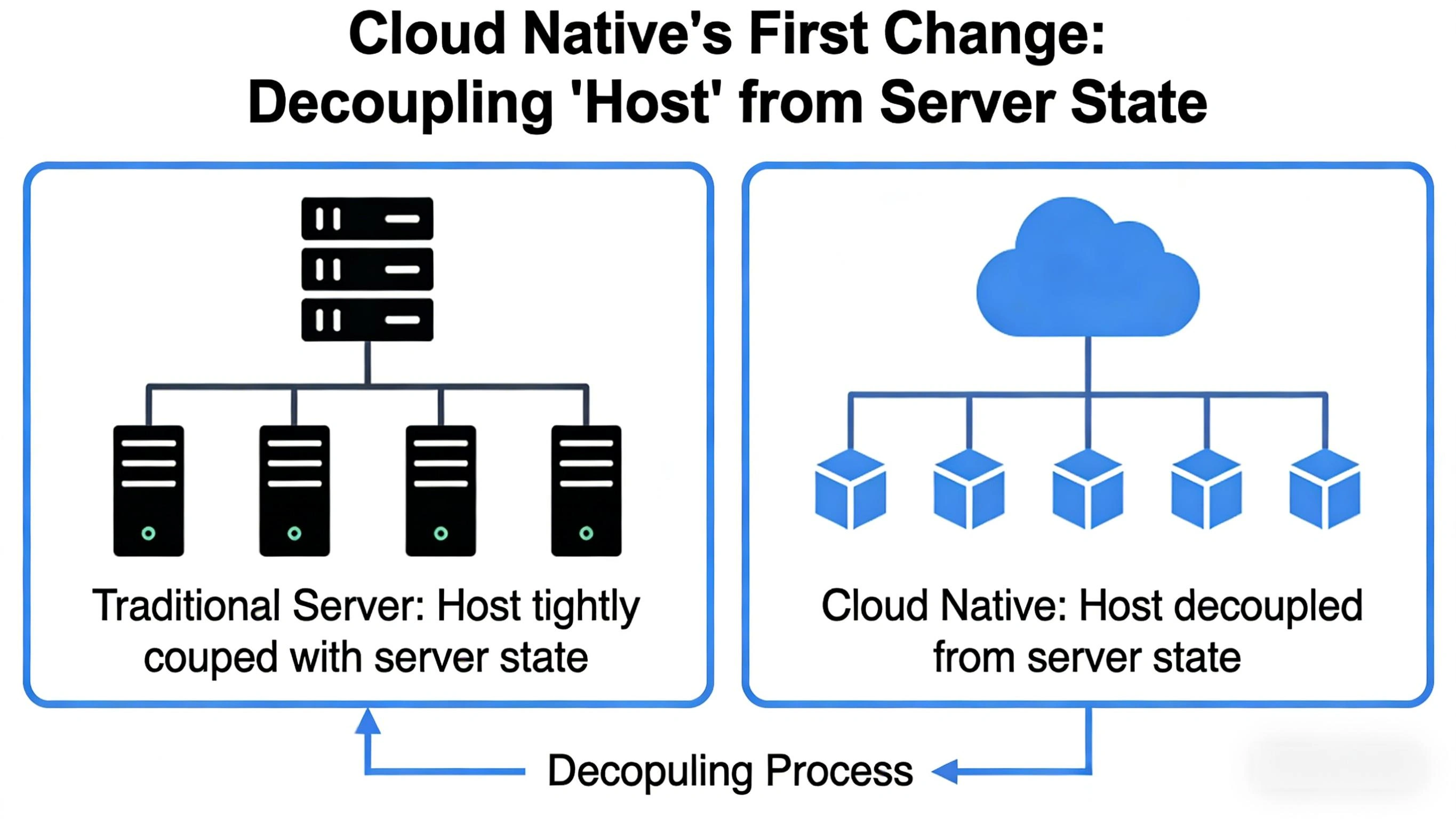
2. The first thing cloud-native changes: decoupling the “host” from the server state
1. Containerization: turning applications into replicable “delivery units”
The starting point for cloud native is often summarized as “containers + Kubernetes”. But what's more important to the hosting industry is not the technology itself, but the fact that it changes the basic unit of delivery and operations.
In the era of web hosting, the “deployment result” is strongly dependent on the state of the server:
- What packages are installed on the machine, what configurations have been changed, dependency version drift, permissions and directory structure ......
- When the same website is moved from machine A to machine B, there is often the specter of “I can run it on that machine, but not on this one”.
Containerization “encapsulates” the application as an image: dependencies, runtime, file structure are fixed, and environment differences are reduced to a handful of controllable variables (environment variables, mounted volumes, network policies). This means two things for hosters:
- Delivery can be scaled: Solidify the “experience of a fellow Ops student” into an image build and deployment pipeline to reduce manual variance.
- Migration and resilience are more straightforward: Application migration is no longer the same as “moving migration”, but rather “starting the same image somewhere else”.
That's why. CNCF's annual surveyThe adoption of containers and Kubernetes will continue to be tracked: they have gone from being “new technologies” to foundational facts of the cloud-native ecosystem, and the CNCF 2024 Annual Survey (published in April 2025) explicitly cites as one of its key findings, “Continued growth in cloud-native adoption, containers in production use, Kubernetes coverage expanding,” among others, The CNCF 2024 Annual Survey (published in April 2025) explicitly cites "continued growth in cloud-native adoption, production use of containers, and expansion of Kubernetes coverage" as one of its key findings.
2. Kubernetes: turning resource pools into “programmable APIs”
If containers make applications replicable, Kubernetes makes infrastructure orchestra-ready. For the hosting industry, this is the equivalent of rewriting “hostability” into a standard set of APIs:
- Calculation: Deployment/StatefulSet/Job
- Web portal: Ingress/Gateway
- Storage: PV/PVC + CSI
- Elasticity: HPA/VPA
- Policies: network isolation, quotas, access control, security policies
The industry-level impact it brings is:Hosts can offer more complex services in a more consistent way。
In the past, when you wanted to make “auto-scaling, cross-availability, rolling releases, canaries, rollbacks” a product feature, it often meant piling up a lot of customized scripts and O&M processes; in the K8s system, these capabilities are more easily “platformized” and become the default capabilities through controllers and policies. In the K8s system, these capabilities are more likely to be "platformized" through controllers and policies and become default capabilities.
More notably, the “relationship between AI loads and Kubernetes” is being discussed more frequently in 2025-2026: a number of materials describe K8s as one of the key infrastructure directions for hosting AI production workloads.CNCF This, in turn, affects the hosting vendor's product line: as customers begin to run both web services and inference services on the same platform, “heterogeneous arithmetic scheduling, GPU pooling, inference gateways, and cost control” are no longer the exclusive domain of cloud vendors.
3. The second thing that cloud-native has changed: the hosting product form factor has moved from “packages” to “platform combinations”.”
Many people mistakenly believe that cloud native only affects large manufacturers and medium to large teams, and that traditional web hosting users are unaffected. But the reality of 2026 is:Cloud Native is “sinking” into a behind-the-scenes default for hosted productsEven though the frontend is still called “web hosting/cloud hosting”.
You'll see several types of typical product forms becoming more common:
1. Managed containers/managed Kubernetes: productizing “cluster operations”
The value of hosting K8s for service providers is not “selling a new name”, but rather turning one of the hardest and most difficult pieces to standardize (cluster upgrades, control plane high availability, patching, security baselines, network and storage plug-in compatibility) into a billable hosted service. Customers are willing to pay for it because it directly reduces the SRE burden within the organization.
2. Application Platform (App Platform / PaaS-enabled hosting): resurrecting “push code to go live”, but with a more modern underpinning.
Traditional web hosting used to have the advantage of “simplicity”. In the cloud-native era, there is a return to encapsulating complexity again, so that the user only cares about the code or image, and the platform takes care of the rest (build, deploy, route, certificates, scaling, rollback). This type of product is particularly attractive to small and medium-sized teams: it's more integrated than “fully hosted static site + a patchwork of third-party services”, and less labor-intensive than “build your own K8s”.
3. Marginalization: making “closer to the user” the default experience
Edge computing is more than just CDNs. a more common combination in 2026:CDN + Edge Functions/Lightweight Computing + Security GatewayThis allows many “host problems” to be moved from the source to the edge: cache hits, proximity authentication, lightweight transformations, anti-crawling and flow limiting, and even partial inference (small models/rules). This allows many "host problems" to be moved from the source to the edge: cache hits, proximity forensics, lightweight transformations, anti-climbing and flow-limiting, and even partial reasoning (small models/rules) can be moved forward. Multiple copiesHosting Trends for 2026 ArticleAll have edge as one of the key directions.
4. Heterogeneous computing power as the “new SKU of the mainframe”
Hosting packages used to be a combination of CPU/RAM/disk permutations. The future is more like: CPU + GPU (or other acceleration) + network/storage performance levels + edge capabilities + security capabilities.Cloud providers such as VultrThe Trends for 2026 article also emphasizes that “heterogeneous computing, edge AI, and sovereign clouds” will reshape the industry.
The common thread behind this is that web hosting is no longer a single form factor, but a “platform capability package”. You're not just buying resources, you're buying a system that “turns resources into usable results”.
4. The first thing that AI Ops has changed: Ops has gone from being a “watchful alarm” to an “executable system”.”
If cloud native addresses “how to deliver more standard, faster, and more scalable”, then AI Ops (AIOps + GenAI/Agent) addresses “how to run more stable, with fewer people, and more predictable”.
1. From Monitoring to Observability to “Actionability”
The industry has been talking about “observability” for the past decade, which centers on expanding the state of the system from three signals (logs, metrics, and tracking) to events, topology, changes, and user experience data, and being able to correlate between these signals.
But in the hosting industry, just being “visible” is not enough, because hosters are dealing with a huge number of tenants and a very high frequency of events. 2026 is the year of change: observable systems increasingly emphasize “actionability” - not only telling you what happened, but also being able to systematize the “next steps”: not only telling you what happened, but also being able to systematize the "next steps". The trend in 2026 is for observable systems to increasingly emphasize "actionability" - the ability to not only tell you what happened, but also to systematize "next steps:
- Alarm noise reduction: de-duplication, aggregation, storm suppression
- Correlation analysis: combining symptoms of the same fault and corresponding changes to abnormalities
- Root cause inference: give the most probable cause and chain of evidence
- Recommendation for disposal: Generate runbook steps
- Automated execution: triggering rollback, rebuild, migrate, restriction, blocking, etc. within the guardrail
- Audit and review: automatic generation of event timelines and improvements, write-back of knowledge base
In a crowded observability market, “AI capabilities, cost optimization, and integration with DevOps” are frequently named as differentiators, reflecting the competition from “seeing” to “doing. The competition from ”seeing" to "doing" is reflected.
2. AIOps“ ”land first, evolve later": Where are the first places in the hosting industry to use AI?
In an ideal narrative, AI O&M would seem to be able to “automatically troubleshoot and heal itself” right out of the gate. But the reality is more simple: the first to hit the ground running are usually theQuickly deliver cost benefits and manageable riskthe scenario. For hosters, the priorities are roughly as follows:
(a) Predictive maintenance and early warning of capacity risks
There are quantifiable trends in hard disk, network, temperature, power, IO latency, and more. Turning “fix it when it breaks” into “migrate/replace it before it breaks” significantly reduces the incident window, especially for multi-tenant platforms.
(b) Alarm noise reduction and event correlation
The mainframe platform alarms are extremely numerous, and the real value is in compressing them into manageable units of events to reduce on-call stress.
(c) Cost optimization (FinOps × AIOps)
Resource idling, overprovisioning, abnormal spikes, hot/cold data tiering, storage lifecycle policies ...... can all be optimized through data-driven optimization. The Observability Platform's emphasis on “cost optimization” also illustrates this point.
(d) Automated disposal (Auto-remediation)
The first actions to be automated are usually low-risk, rollbackable, and have clear impact boundaries: reboots, rebuilds, migrations, scale-ups and scale-downs, stream cuts, blocking, etc. In the hosting industry, the hard part is not writing scripts, but controlling multi-tenant impact. In the hosting industry, the difficulty of automation is often not “writing scripts”, but “multi-tenant impact control”.
3. Generative AI and Intelligentsia: Moving O&M from a “suggestion system” to an “orchestration system”
AIOps traditionally favored statistics/rules/machine learning: anomaly detection, correlation analysis, predictive trending. The addition of Generative AI (GenAI) and agents changes the “human-computer interaction and process orchestration”:
- Enable Ops to query and attribute in natural language, “Which cluster error rate increase in the last 30 minutes correlates most with recent changes?”
- Enable the system to break down complex dispositions into steps: pull logs, check metrics, check against changes, generate fix PRs, trigger grayscale, observe regressions
- Make knowledge deposition more automatic: incident review, FAQ, SOP update, work order summary
Gartner in Materials related to the AI Hype Cycle 2025AI agents are considered one of the fastest advancing technologies, which is in line with the general direction of “Intelligence into Ops/Security/Dev workflows”.
But more to the point:The hosting industry will not accept “black box automation.”. All it takes is one misdisposal to extend the impact (e.g., mistakenly blocking a large amount of normal traffic, mistakenly deleting volumes, mistakenly cutting streams), and the damage can instantly be magnified to the brand level. So truly usable agentic ops in 2026 will require three things:
- guardrail: Least privilege, hierarchical authorization, strong auditing;
- Observable guardrails: Every step of the way there is evidence with replay that explains why it was done;
- Failure Fence: Timeout/rollback/manual takeover mechanism is clear.
security industryAttitude towards agentic AIA similar logic applies: interest is high, but the percentage of those actually “fully on the ground” is not high, reflecting governance and risk concerns.
6. The most dramatic change in the web hosting industry after the overlay of cloud-native + AI O&M: value delivery methods and cost structures
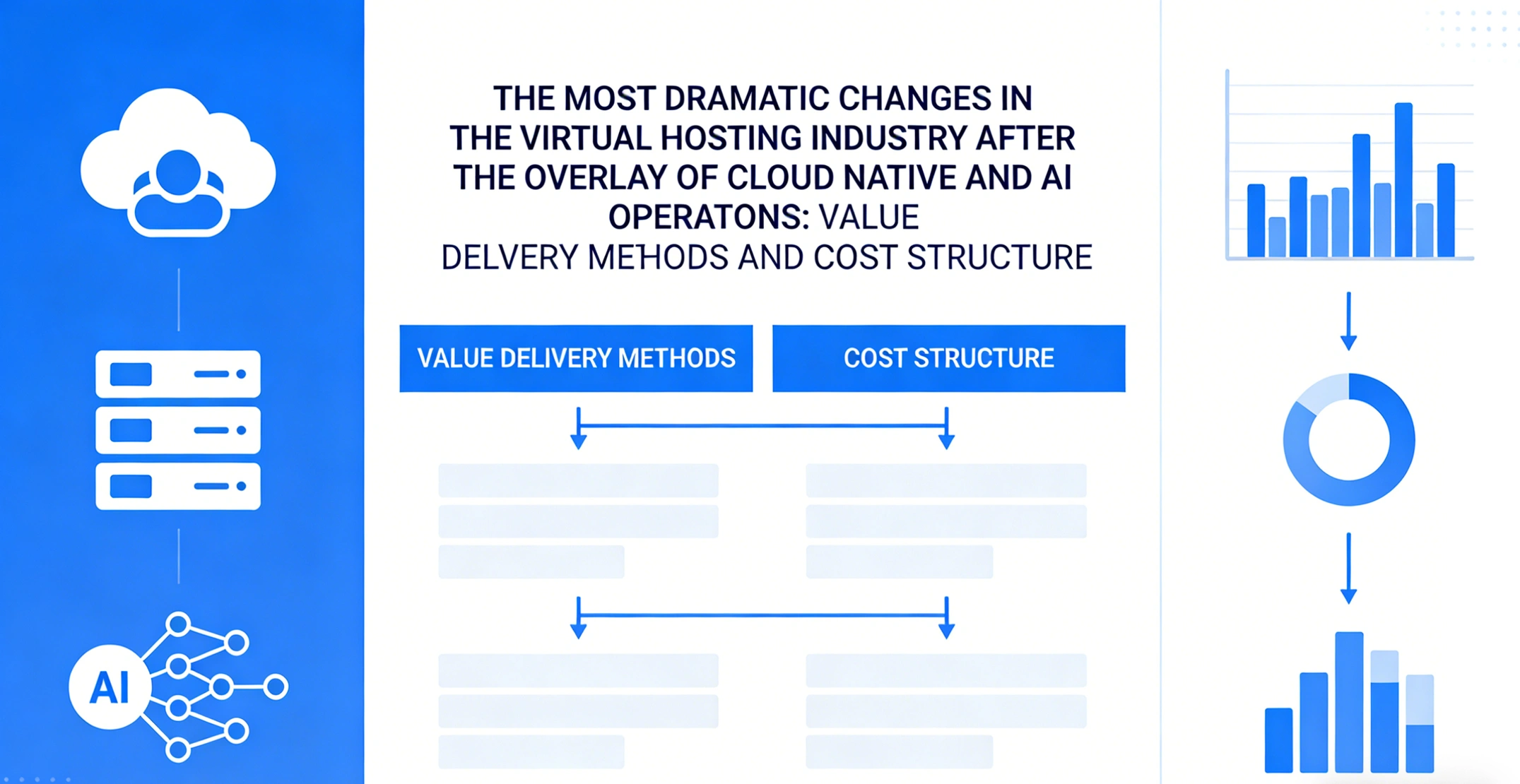
When cloud-native and AI Ops mature separately, they stack up to produce an industry-grade consequence:Hosters are becoming more like “cloud platform companies” rather than “server sellers”.”. This statement sounds like a slogan, but it can be broken down into very specific changes.
1. From “selling resources” to “selling results”: SLAs, performance, security, speed of delivery as payment points
Traditional hosting pricing revolves around resources: CPU/Memory/Disk/Traffic. In the age of Cloud Native + AIOps, customers are increasingly willing to pay for results:
- Faster online:: From “manual deployment/work order turn-up” to “minute-by-minute delivery”
- Shorter MTTR:: From “find and check” to “auto-association + recommendation/auto-disposal”
- More stable performance: Reducing jitter through elasticity, edges, caching and auto-scheduling
- Stronger security: WAF, DDoS, Anti-Burst, Backup & Ransom Recovery as defaults
- More predictable costs: FinOps and governance capabilities transform costs from “bill shock” to “unit cost management”.”
Hosting Trends ArticlesThe repeated emphasis on AI automation, edge, security, and sustainability is essentially “result-oriented” productization.
2. Shift in cost structure from “hardware + labor support” to “platform development + automation economies of scale”
The big cost headaches for traditional hosts are usually: server room/bandwidth/hardware depreciation + support team (work orders/phone calls/chat) + a small amount of research and development.
But with platformization, the cost curve changes:
- Unit hardware costs still matter, but resource utilization and scheduling capabilities determine the gross profit ceiling;
- The greater the automation capability, the lower the support cost per unit tenant;
- The more mature the observable and event system, the more manageable the cost of accidents;
- Platform R&D investment rises, but marginal delivery costs fall and scale effects are stronger.
This explains why a number of cloud and managed services companies are in the 2025-2026 Emphasis“AI helps customers to land and operate” and even use it to adjust business models and service organizations.
3. Increased industry fragmentation: low-priced shared hosting will still exist, but “mid-range and high-end hosting platforms” will grow more rapidly
In 2026 you will see three parallel routes:
- Extreme Low Cost Shared Hosting: Still serves the long tail (small sites, ad-hoc projects, very low budget users), but with more pressure on security and support, and thinner margins.
- Scenario-based hostingWordPress hosting, e-commerce hosting, game hosting, overseas acceleration hosting, etc., with performance optimization, security and on behalf of the operation and maintenance as a premium point.
- Platform Service ProviderHosting K8s, application platform, edge and security integration, service more specialized customers, higher unit price but competition is more biased technology and operational capabilities.
6. The most notable “new defaults” for 2026: not a trend, but a threshold
A lot of articles on trends tend to treat all new things as “going to happen”. But here are some more definitive judgments for 2026: they are no longer “optional” but will become part of the hosting landscape.new threshold。
1. Security capabilities are built in by default, not optional at an additional cost
In the past, “backup, WAF, DDoS” were often regarded as value-added items. Now that the cost of attacks has dropped and automated attacks have become popular, security has become a retention issue: once a user's website is mounted, ransomed or blown up, the probability of migration is extremely high. Hosts tend to make basic protection the default, and put more advanced security (stronger WAF, proprietary protection, compliance auditing, zero-trust access) as a premium package. For 2026Hosting Trends ArticlesThe focus on “security enhancement” is also in line with this reality.
2. Observability from “O&M tool” to “product experience”
As customers increasingly buy “results”, they will demand to see evidence: latency, availability, error rates, resource consumption, cost attribution. This means that observational data is not just for internal SRE, but also becomes part of external services: dashboards, SLA statements, audit logs, event notifications.Observable marketsThe emphasis on “AI capabilities + cost optimization + DevOps integration” maps to this.
3. Upgrading automated operations from “scripts” to “governable workflows”
Automation in 2026 will be less about scattered scripts and more about “workflow systems with approvals, audits, and rollbacks”:
- Automatic execution of low-risk actions
- Medium-risk moves require human confirmation
- High-risk maneuvers only provide advice and chain of evidence
And every step is replayable, traceable and reviewable. This is also the key to whether agentic ops can really get off the ground.
4. Edge capabilities as infrastructure for a globalized web site
When overseas and cross-region access becomes the norm, source optimization alone is not enough. Edge caching, proximity routing, edge security, and edge computing will become more and more the “default”. Multiple copiesHost Trend MaterialsThe emphasis on edge suggests a shift from “optional acceleration” to “experience infrastructure”.
7. What does it mean for different populations: how do users and service providers choose?
For individual webmasters and small teams: you'll see “more platform-like hosting”.”
You may not want to learn Kubernetes or study observability. But you'll enjoy the productized results they bring: faster deployments, more consistent performance, fewer failures, and more automated backups and protection. The more realistic question on choice becomes:
- Is your business more of a “content site/marketing site” or an “application/service”?
- Do you need global users? Need edge acceleration and security?
- Do you need to integrate with CI/CD (teamwork)?
- How much “platform bonding” (migration costs) are you comfortable with?
For this type of user, 2026“s best practice is often not to chase the latest, but to pick a platform host that ”encapsulates the complexity best" in your scenario:
- Content site: emphasizes CDN/edge, backup, security, ease of use
- Application stations: emphasize deployment pipeline, rollback, observation, scalability
For Medium to Large Teams and SaaS: Mainframe Selection Will Be More Like a “Platform Architecture Decision”
It's no longer “some machine can run” that you care about:
- Multi-environment consistency (dev/stage/prod)
- Publishing strategy (grayscale, canary, rollback)
- SLO/SLI and Observability
- Compliance and Audit (especially offshore and data residency)
- Cost Attribution (FinOps)
- Supply chain security (mirror signatures, dependency vulnerabilities)
This will turn “hosting procurement” into “platform capability assessment”, and even treat hosting vendors as platform partners, not just resource providers.
For hosting service providers: the core of competition from “selling resources” to “platform engineering + operation engineering”.”
The real moat for hosters in 2026 will be increasingly focused on three types of capabilities:
- Platform engineering capabilities: Make cloud-native capabilities into stable products, not bulk components.
- Operations Engineering Capabilities (SRE/AIOps): Incident response, automated disposal, capacity and cost governance, observability and auditing.
- Scenario-based product capabilities: Packaging common capabilities into solutions that are usable for specific industries/applications (WP, e-commerce, offshore, AI reasoning, etc.).
8. Final Verdict: Web hosting in 2026-2028 will move towards “fewer people + stronger platforms + clearer boundaries of responsibility”.”
Wrap up the entire text into a clear conclusion:
Cloud Native makes hosting from “machine slicing” to “platform resource pooling”; AI O&M makes O&M from “manual experience” to “data-driven executable system”. AI operation and maintenance turns operation and maintenance from "manual experience" into "data-driven executable system".
Together they are driving three long-term changes in the web hosting industry:
- Moving the boundaries of responsibility upwards: Users are less and less likely to run and maintain their own bottom line, and hosters are offering stronger hosting and platform capabilities;
- Rising automation density: More automated from turn-up and deployment to capacity expansion and contraction, repair, and review;
- Security and observability become the default: Because without them, the bigger the platform, the less controllable the risk.
At the same time it must be recognized:
- Intelligent body operation and maintenance will not be “fully automated” overnight, but more realistically “AI generates recommendations + automated controlled execution + human approval backing”;
- Low-cost shared hosting won't go away, but it will rely more and more on automation and security baselines to maintain operability;
- The new differentiator is not “is there cloud native/AI”, but “is it reliable, is it governable, can it really encapsulate complexity”.
summarize
Web hosting in 2026 is moving from “selling a block of server resources” to “selling a set of application platforms that can be delivered, governed, and operated sustainably”.cloud nativeRewrite the underlying provisioning of hosts into a pool of programmable resources: containerization makes delivery more consistent, and Kubernetes/platform engineering makes scaling up and down, releases, rollbacks, and security policies easier to productize;AI Operations and MaintenanceIt advances the operation phase from “alarm-driven human troubleshooting” to “data-driven correlation analysis + controlled automation disposal + auditable review”, making scale operation possible.
For users, choosing a host should not be based on CPU/memory/bandwidth only, but rather move the focus to “results”:Can it go live quickly, can failures be recovered quickly, is it secure by default, is it observable, is it cost predictableIt is not a good idea to make the cloud native into a stable product. For service providers, the real moat is no longer the server room or low price, but the cloud native into a stable product, AI operation and maintenance into a manageable workflow, and around the scene (WordPress, e-commerce, overseas, AI reasoning, etc.) to encapsulate the complexity of the experience can be directly purchased. In the end, the industry will move towards a more obvious stratification: the low-priced long tail will remain, but higher growth and higher premium will be concentrated in the “platform hosting + automated operation and maintenance + security integration” service form.
common problems
Q1: Will cloud native “wipe out” traditional web hosting?
A: No. Traditional web hosting (especially shared hosting, panel hosting) still has a large long-tail market: small sites, temporary projects, very low budget users need “cheap + worry”. But cloud native will transform it into “more cloud native in the background, more stupid in the foreground”: what you see may still be one-click WordPress installation, automatic backups, automatic renewal of certificates; only that the way of operation behind the scenes has gradually changed from “stand-alone configuration stacking” to “platform scheduling + platform hosting”. "platformized scheduling + automated delivery".
Q2: I'm just doing an enterprise website/blog, do I need to care about Kubernetes?
A: Most likely you won't have to “learn Kubernetes”, but you will benefit indirectly: more stable isolation, faster migration, more resilience and automation. It's not so much the details of K8s that you need to care about, it's whether the hosting provider can offer: automated backup and recovery, WAF/DDoS infrastructure protection, stable performance, observability/alerting (or at least visibility into the cause of anomalies), and the ability to “roll back/recover from a problem quickly”.
Q3: Does AI Ops mean “use ChatGPT to help me troubleshoot”?
A: That's a very small part of it. Real AI Ops is more like three layers:
- Intelligent Analytics Layer: Anomaly detection, alarm noise reduction, correlation analysis, root cause inference;
- Knowledge and Process Layers: Sink experience into SOP/Runbook to make processing replicable;
- controlled executive level: Automatically triggers repair/rollback/quarantine, but must be auditable, guardrailed, and rollable.
Therefore, AI O&M is not just about “being able to chat”, but about “being able to string diagnosis and disposal into a security workflow”.
Q4: What are the biggest risks of AI Ops?
A: Three categories:
- Illusion/misjudgment: To give seemingly reasonable but erroneous conclusions or operational recommendations;
- Ultra vires and key risks: Intelligence requires permissions to invoke tools, and permissions boundaries can become “automation breakers” if not done properly;
- unauditable: Not being able to say “why, what, and who” when things go wrong is especially deadly in multi-tenant environments.
Mature practices are usually: low risk automated execution, medium risk requires approval, high risk only advice + chain of evidence.
Q5: Will Cloud Native + AI Ops be more expensive or cheaper for hosting?
A: The polarization is more pronounced:
- Basic PackagePossibly cheaper (more automation, lower unit O&M costs, higher resource scheduling density);
- High-end PackageIt will be more expensive (SLAs, dedicated resources, enhanced security, compliance audits, managed services, specialized support).
You'll see a structure where “the low price is still there, but the premium at the high end is more reasonable”.
Q6:Why do 2026 hosts emphasize on Edge? Can't I just use a CDN?
A: The edge is upgrading from “caching static content” to “processing requests nearby”: forensics, stream limiting, anti-crawling, lightweight computing, and API gateway capabilities are moving forward, which significantly reduces pressure and latency at the source site and improves anti-attack capabilities. CDN is part of the edge, but the edge is more like “moving part of the business logic and security capabilities to a place closer to the user”.
Q7: What are the 5 most critical checkpoints when choosing a hosting/cloud platform?
A (in common order of importance):
- Backup and Recovery: Is the backup automatic by default? Is recovery one-click? Does it support off-site backup?
- security baseline: Are WAF/anti-blast/DDoS base capabilities default? How are patching and quarantine policies done?
- Observable and alarming: Can you see performance/errors/resources? Can it be quickly localized in case of failure?
- Delivery and Rollback: Does it support CI/CD or at least painless rollback?
- Cost predictability: Have a clear view of billing, resource quotas and usage to avoid “bill shock”.
Q8: What is the most difficult point of cloud-native transformation for hosters?
A: Usually it's not “run the container up” but three things:
- Multi-tenant isolation and resource governance: Safety, quotas, noise neighbor issues;
- Observable and Event Systems: Stable operations cannot be scaled without a unified event center;
- Platform engineering organizational capacity: To make complex systems into products with continuous iteration and stable upgrades.
Q9:What are the most likely “new standard features” in the web hosting industry in the next 1-2 years?
A: It's more certain that it will become more common there:
- Automatic certificates with auto-renewal, mandatory HTTPS;
- Default backup + self-restore;
- Default security (at least anti-blast/WAF base rules);
- Better performance isolation (less “neighbor noise”);
- Enhanced deployment experience (evolving from “upload files” to “auto-build/one-click publish”);
- More explicit notification of observations and events (even small packages give basic visualization).
Q10: I'd like to make the end of the article a “Reader Action Suggestion”, give me a one sentence version of the suggestion?
A:
- subscribersPrioritize buying hosts that are “resilient, secure by default, observable, and rollable”, not just CPU/memory.
- service providerCloud Native as a stable platform, AIOps as an auditable workflow, and pricing and competing on results (SLAs/security/speed to market) rather than resources.
 English