











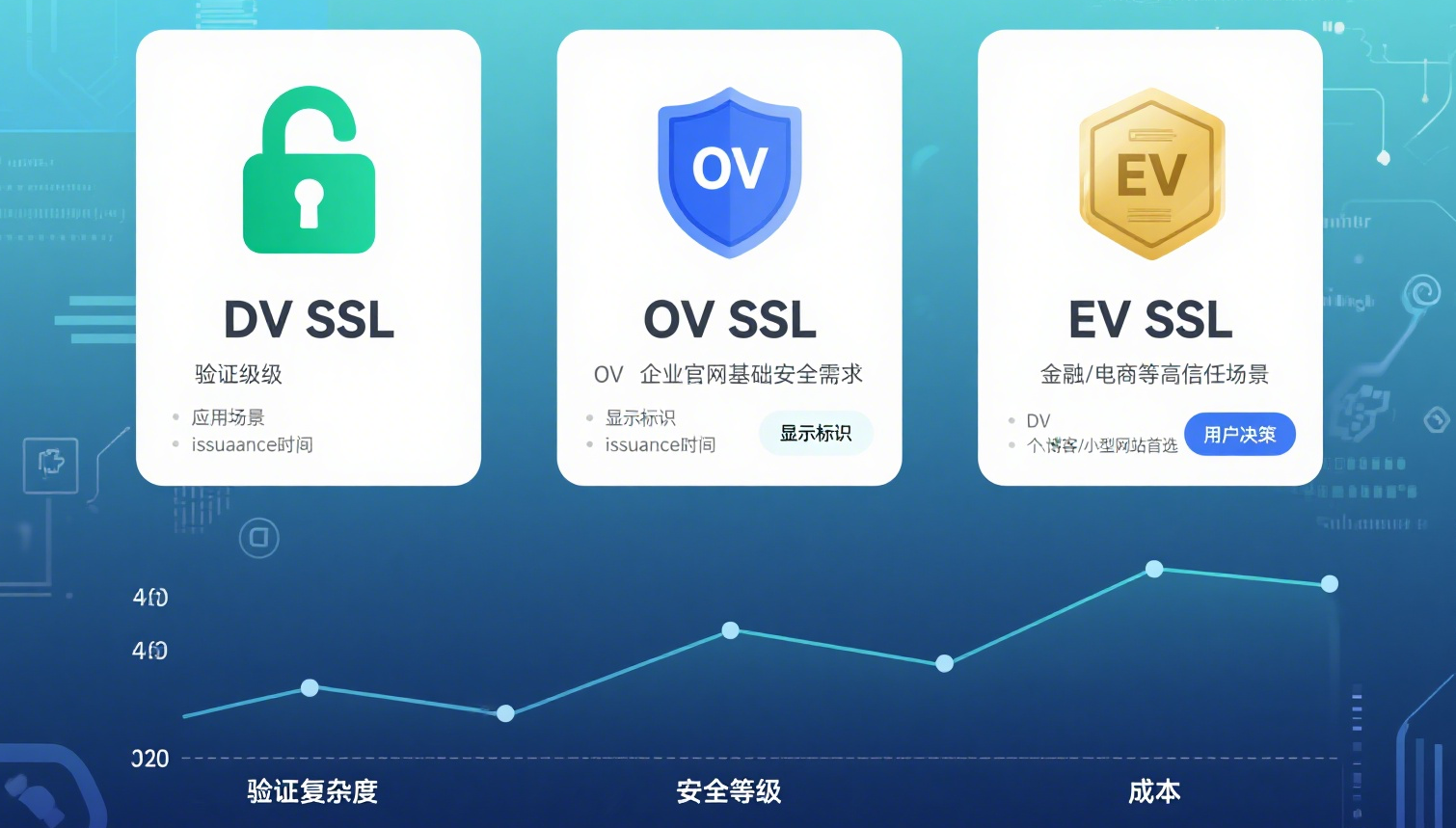
In today's digital era, website security has become a crucial aspect that cannot be overlooked by businesses and individual users. As a core tool for securing website data transmission, the choice of SSL certificates directly impacts user trust and website security. The mainstream SSL certificates currently available on the market are primarily categorized into three types:Domain Validation (DV)、Organization Validation (OV) andExtended Validation (EV). This article will provide a detailed analysis of the differences between these three certificate types to help you make the right choice based on your specific needs.
I. Core Functions of SSL Certificates
Before understanding the specific types, we first need to clarify the core functions of SSL certificates:
- Encrypting Data Transmission: Encrypts communication between the browser and server via the SSL/TLS protocol to prevent data theft or tampering.
- Identity Authentication: Verifies the authenticity of a website, preventing users from accessing phishing sites.
- Enhancing Trust: Browsers display the website's security status to users through indicators such as the lock icon in the address bar and the HTTPS prefix.
II. In-depth Analysis of the Three Major SSL Certificate Types
2.1 Domain Validation (DV SSL)
Definition: DV SSL is the certificate type with the lowest validation threshold, verifying only the applicant's ownership of the domain name.
Core Features:
- Validation Method: Confirms the applicant's administrative authority over the domain through methods such as email verification, DNS resolution, or file upload, without validating organizational information.
- **Issuance Speed**: Verification and certificate issuance can be completed in as little as a few minutes.
- Display Indicators: The address bar displays theHTTPS prefixandand thelock icon
- Applicable Scenarios:
- , with no organizational information shown.
- Personal blogs, small websites
- Static websites requiring only basic encryption functionality
- PricesDevelopment and testing environments
: Lowest cost; many providers offer free DV certificates (e.g., Let's Encrypt).
Rainbow Aggregation DNS Management System Introduction: The Rainbow Aggregation DNS Management System is a professional domain name resolution management tool developed based on the ThinkPHP framework, designed to provide users with a unified interface for managing DNS resolution services across multiple cloud service providers. By integrating APIs from mainstream DNS service providers, the system enables... View Original
- Advantages and Limitations:
- ✅ Advantages: Rapid deployment, low cost, meets basic encryption needs.
❌ Limitations: Does not validate organizational identity, cannot prove the authenticity of the entity behind the website, and offers weaker phishing protection.
Definition2.2 Organization Validation (OV SSL)
Core Features:
- Validation Method:
- : OV SSL verifies the authenticity and legitimacy of the applying organization in addition to validating domain name ownership.
- Validate domain name ownership (same as DV);
- Verify the organization's official information, such as business registration details, address, and phone number.
- Display Indicators: The address bar displays theHTTPS prefix、and the**Issuance Speed**: Typically requires 1-3 business days.
- Applicable Scenarios:
- , where organizational name and other details can be viewed upon clicking.
- Corporate websites, small to medium-sized e-commerce sites
- Platforms that need to prove organizational authenticity to users
- PricesWebsites with certain security requirements but not needing the highest level of certification
Rainbow Aggregation DNS Management System Introduction: The Rainbow Aggregation DNS Management System is a professional domain name resolution management tool developed based on the ThinkPHP framework, designed to provide users with a unified interface for managing DNS resolution services across multiple cloud service providers. By integrating APIs from mainstream DNS service providers, the system enables... View Original
- : Moderate, usually ranging from several hundred to several thousand yuan per year.
- ✅ Advantages: Balances security and cost, effectively proves organizational identity, and enhances user trust.
❌ Limitations: Validation process is more complex than DV, and does not display a green address bar (compared to EV).

Visit Recommended SSL Service Providers
Definition2.3 Extended Validation (EV SSL)
Core Features:
- Validation Method:
- : EV SSL is currently the certificate type with the highest security level, employing the most stringent validation standards to comprehensively verify the legitimacy and authenticity of the organization.
- Validate domain name ownership;
- Conduct in-depth verification of the organization's legal status, physical address, and operational status;
- Confirm the authorization qualifications of the applying representative.
- Display Indicators:
- **Issuance Speed**: Typically requires 3-7 business days.The address bar displays agreen background
- and shows the organization name (some browser designs may simplify this);
- Applicable Scenarios:
- Fully displays enterprise information (including country, city, and institution name).
- Financial institutions (banks, payment platforms)
- E-commerce websites (especially platforms involving large transactions)
- Platforms with extremely high user trust requirements
- Prices: Highest, typically starting at several thousand yuan per year.
Rainbow Aggregation DNS Management System Introduction: The Rainbow Aggregation DNS Management System is a professional domain name resolution management tool developed based on the ThinkPHP framework, designed to provide users with a unified interface for managing DNS resolution services across multiple cloud service providers. By integrating APIs from mainstream DNS service providers, the system enables... View Original
- ✅ Advantages: Highest level of identity authentication, significantly enhances user trust, effectively prevents phishing attacks.
- ❌ Limitations: Complex verification process, high cost, long issuance cycle.


III. How to Choose the Right SSL Certificate for Your Needs?
3.1 Key Decision Factors
- Website Type and Purpose: E-commerce and financial websites require higher security levels, while personal blogs can opt for basic types.
- User Trust Requirements: Whether it is necessary to emphasize the authenticity and legitimacy of the organization to users.
- Budget and Cost: EV certificates are significantly more expensive than DV and OV.
- Deployment Time: For scenarios requiring rapid launch, prioritize DV certificates.
3.2 Scenario-Based Selection Recommendations
| Scenario | Recommended Certificate Type | Core Reason |
|---|---|---|
| Personal Blogs, Static Display Sites | \nDV SSL | Low cost, fast deployment, meets basic encryption needs |
| Corporate Websites, Small to Medium-sized E-commerce | \nOV SSL | Balances security and cost, proves organizational authenticity |
| Banks, Payment Platforms, Large E-commerce | EV SSL | Highest level of certification, maximizes user trust, prevents phishing |
| Static websites requiring only basic encryption functionality | \nDV SSL | Temporary use, no complex verification required |
IV. Summary
Choosing an SSL certificate is not about selecting the highest level, but aboutmatching your own needs.:
- Pursuinglow cost and rapid deployment: Choose DV SSL;
- 需Proving organizational identity while controlling costs: Choose OV SSL;
- Involvinghighly sensitive business or large transactions: Choose EV SSL.
Regardless of the type chosen, deploying an SSL certificate is a fundamental step in ensuring website security. As browsers increasingly enforce HTTPS requirements (e.g., Chrome marking HTTP sites as “Not Secure”), configuring an SSL certificate for a website has become a necessity, not an option.

 English