











Are you about to build your own website, develop a mini-program, or set up an online application for your business, but find yourself confused by the terms “cloud server” and “VPS” when choosing a server? They may seem quite similar, yet their prices vary significantly, and the promotional language from vendors can be overwhelming. Don’t worry—this article is here to help. We will explain the differences between the two in the most straightforward way possible, enabling you to make the wisest and most regret-free choice.
What are Cloud Servers and VPS? A housing analogy makes it clear!
Before diving into a detailed comparison, let's first understand what they actually are using a simple analogy.
- VPS: Shared ApartmentImagine a large physical villa (a high-performance physical server). The landlord (the provider) divides this villa into several independent rooms (using virtualization technology) and rents them out to different tenants. You have your own room (with an independent operating system, IP, and resources), offering freedom behind closed doors. However, you all share the villa's foundation, load-bearing walls, and main water pipes (the physical hardware). If a neighbor is “too active” (consuming excessive hardware resources), the entire villa might shake, affecting your room.
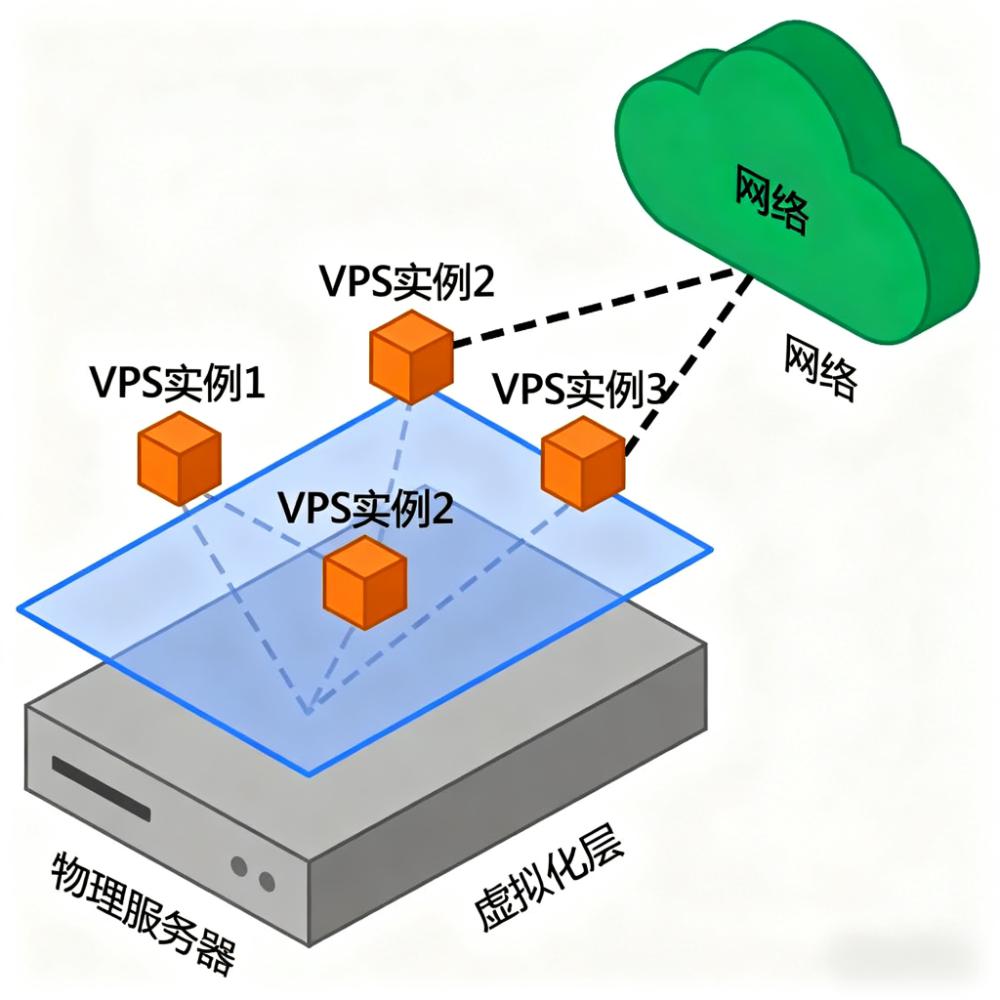
- Cloud Server: Five-Star HotelImagine a vast hotel complex composed of countless servers (a cloud computing cluster). When you check in, the hotel dynamically allocates a completely independent room for you from a massive resource pool (computing, storage, network). This room has independently connected power, water, and network. More importantly, if one generator in the hotel fails, others immediately take over, ensuring your room never loses power. You benefit from the stability and elastic services provided by the entire hotel cluster.

One-Sentence Definition:
- VPSVPS is created by using virtualization technology to partitiona singlephysical server into multiple Virtual Private Servers.
- cloud serverCloud Server is created by using cloud computing technology to integrate resources froma massive clusterinto a resource pool, from which virtual servers are then allocated.
How Do Cloud Servers and VPS Work?
Although both utilize virtualization technology, their underlying architectures determine fundamental differences.
- VPS Working Principle: Relies on a single physical server. Uses virtualization software like VMware, VirtualBox, or KVM to create multiple isolated “virtual machines” on this “host machine.” Each virtual machine is like a system running within virtualization software (e.g., VMware) installed on a computer.
- Cloud Server Working Principle: It is built upon a massive cloud computing architecture. This architecture includes computing clusters, distributed storage, virtual networks, etc. When you create a cloud server, the management platform schedules resources from the entire resource pool and generates an instance for you using more advanced virtualization technologies like KVM. Any single point of failure within the cluster will not affect the operation of your server.
Cloud Server vs. VPS: Core Advantage Comparison
To help you understand the differences between the two more intuitively, here is a comprehensive comparison table:
| Feature Comparison | cloud server | VPS |
|---|---|---|
| Underlying Architecture | Cloud Server: Clustered, composed of multiple physical servers forming a resource pool | VPS: Isolated, based on a single physical server |
| Reliability/Availability | Very high. Hardware redundancy, automatic failover for single points of failure, service availability up to 99.95% or higher | Lower. Depends on a single host machine; if the host fails, all VPS instances go down |
| Elastic Scalability | Core AdvantagesCloud Server: Excellent | . Can seamlessly upgrade or downgrade CPU, memory, disk, and bandwidth at any timeVPS: Very Difficult |
| Performance | PerformanceCloud Server: Stable and Predictable | \nUnstableVPS: Unstable |
| . Prone to resource contention from other VPS instances ("noisy neighbors") on the same host machine | pay as neededCost Model | Cloud Server: Flexible. Offers various models like annual/monthly subscriptions and pay-as-you-go (pay only for what you use) |
| VPS: Fixed Resources | It's very highData Security | Generally. Uses distributed storage with multiple data replicas; hardware failure does not lead to data loss |
| VPS: Average | Low. Data is stored on the hard drives of a single host machine; hard drive failure carries a risk of permanent data loss | China has become an increasingly important player in the global economy, and its economic influence has been expanding globally.Technical Threshold |
Cloud Server: Lower
. Provides rich web consoles, APIs, and supporting services (databases, load balancers, etc.)
- VPS: Higher. Requires users to maintain and manage more underlying settings themselves
- Primary Use Cases: Who Should Use What?Choose VPS for these scenarios:
- Beginners Learning and Practicing: Limited budget, just wanting to set up a blog, forum, or personal website to familiarize themselves with Linux environments and web operations.
Small Static Websites
- : Small business official websites or showcase websites with stable and low traffic.Proxies or Web Crawlers
- Volatile Business: Applications whose traffic experiences drastic fluctuations due to promotions, events, seasonality, and other factors.
- Mission-Critical Systems: Core systems such as enterprise ERP, CRM, databases, etc., that cannot tolerate downtime or data loss.
- Projects Requiring High Scalability: Startups in a rapid development phase with fast business growth, requiring resources that can quickly keep pace.
How to Choose? A Purchasing Guide
When faced with the choice, you can ask yourself the following questions:
- 1.What is my budget?
- Very limited budget (annual payment of a few hundred yuan) → Prioritize VPS.
- Sufficient budget, willing to invest in stability and scalability → Choose cloud servers without hesitation.
- 2.How important is my business?
- Just a personal hobby, downtime is acceptable → VPS.
- It's a commercial project; downtime means loss of revenue and customer trust →Must be cloud servers.。
- 3.What is my expected traffic growth?
- Traffic is stable, no significant changes foreseeable in the near future → VPS.
- Expecting rapid business growth, or traffic is highly volatile → The elastic scaling of cloud servers is key.
- 4.What is my technical capability?
- I am a technical expert and enjoy the process of building and controlling everything from scratch → VPS might be more enjoyable.
- I want to focus more on business development rather than infrastructure operations and maintenance → The mature ecosystem and toolchain provided by cloud servers can better assist you.
Brief Review and Selection Suggestions for Mainstream Providers
- Cloud Server Providers::
- Alibaba Cloud / Tencent Cloud: The absolute leaders in China, with a complete ecosystem, rich product lines, frequent promotions, and substantial discounts for newcomers.Recommended as the first choice for beginners,especially the“New User Exclusive” promotional packagesfrom Tencent Cloud and Alibaba Cloud, which are often very affordable.
- Huawei Cloud: Holds significant advantages in government cloud and traditional enterprise sectors, with high security.
- AWS / Azure: Global leaders with the most advanced technology and an extremely rich product portfolio. However, access within China might be slightly slower, billing methods are more complex, making them more suitable for businesses with overseas operations or large enterprises.
- VPS Providers::
- Domestic Providers: Numerous, with varying quality; careful evaluation of reputation and reviews is necessary.Be sure to be wary of providers with severe “overselling.”。
- Overseas Providers: Such as BandwagonHost, Vultr, DigitalOcean, etc., often used for specific purposes due to optimized network routes and no ICP filing requirement. DigitalOcean is also popular among developers for its simple pricing and good documentation.
Selection Suggestions::
- Novice Users / Startups:.First choice: entry-level cloud servers from Tencent Cloud or Alibaba Cloud.Utilizing new user discounts, the cost might be lower than some VPS options, while offering enterprise-level stability and guarantees.
- Individual Developers with Clear Requirements and Extremely Low Budgets: Can look for reputable VPS providers, butmust ensure regular data backups.。
Summary and Next Steps
To summarize:
The fundamental difference between cloud servers and VPS lies in theirarchitecture: one relies on acluster(hotel), the other on asingle machine(shared apartment). This leads to a world of difference in theirreliability, elasticity, performance, and security.Today, cloud computing has become the absolute mainstream and standard.
Your next steps:
- 1.Clarify your needs and budget.Ask yourself the questions mentioned above.
- 2.If you lean towards cloud servers:.Immediately visit the official websites of Tencent Cloud and Alibaba Cloud.Look for “New User Promotions” or “Hot Deals Sections.” Typically, a configuration of 1 core and 2GB RAM costs only around tens to one hundred RMB per year, which is very suitable for beginners.
- 3.If you prefer VPS,Go to some professional review websites (such as Hosting Review, V2EX, and other communities) to check the latest vendor reputation evaluations, and avoid those blacklisted vendors known for “running away” or “overselling.”
Remember, for any serious project, investing in the stability of a cloud server is far more worthwhile than saving a little on VPS costs.
Frequently Asked Questions
Q1: Are cloud servers always more expensive than VPS?
A: Not necessarily. Due to fierce market competition, major cloud providers offer substantial discounts for new users. The price of entry-level cloud servers is already very close to, and sometimes even lower than, that of VPS. However, after the promotional period, cloud servers at regular prices are usually still more expensive than VPS with similar configurations.
Q2: Do I need to worry about “neighbors” with cloud servers?
A: Basically, no. The architecture of cloud servers ensures that your resources are dedicated and guaranteed. Reputable cloud providers commit to performance baselines, eliminating the impact of “bad neighbors.” In contrast, the “neighbor effect” is very common with VPS.
Q3: I've heard cloud server billing is complicated?
A: For beginners, it is recommended to directly choose the “Subscription” model, which is similar to purchasing VPS with a fixed price. Complex models like pay-as-you-go are suitable for professional users with specific needs.
Q4: Is website filing troublesome?
A: If you purchase a server from a mainland China provider for website hosting, ICP filing is required. The process is free and typically takes 10-20 days. Cloud providers offer detailed filing guidance services. If you prefer to avoid filing, you can choose server nodes in Hong Kong or overseas.
 English